

Turning Strategy Into Execution With Smarter Digital Platforms
Every leader has a plan. Making it happen is the actual issue, not coming up with one.
Companies today don’t work in quarterly cycles; they work in real time. Plans change every day, decisions affect people all over the world, and teams need to turn huge ideas into real outcomes faster than before. A strategy without execution is just a slide presentation, and execution without clarity is a mess. Technology that connects people, purpose, and progress is what brings the two together.
That’s why smart digital ecosystems—platforms that bring together planning, communication, and measurement—are so important in today’s workplaces. The best project management tools in this area don’t only keep track of tasks; they also help make changes happen.
Lark is one of those things that has changed how businesses get from planning to doing. It makes a digital rhythm that makes all messages, milestones, and metrics work together, turning a vision into a demonstrable effect.
Let’s look at how its most important aspects assist organizations go from planning to doing.
Lark Base: Where strategy takes shape in data
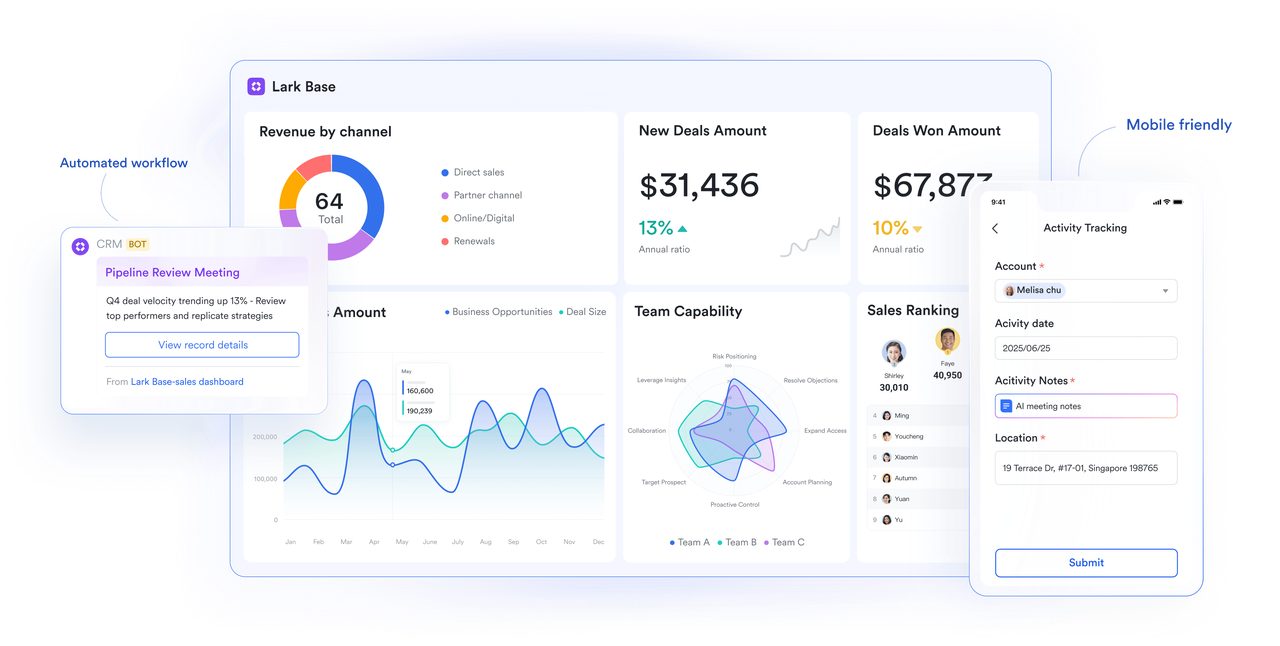
Data drives every strategic decision, yet for many leaders, that data remains trapped in spreadsheets or buried in static reports. Lark Base transforms fragmented information into a single, real-time view of organizational performance.
Base serves as a digital command center, allowing teams to create structured databases for any purpose—tracking campaigns, monitoring operations, or managing project portfolios—without technical complexity. For instance, a marketing manager overseeing multiple launches can view all projects, budgets, and deliverables in one place, updated automatically as teams make progress through an automated workflow that keeps every data point in sync.
But Base goes beyond showing what’s happening—it provides context. Leaders can see not only performance outcomes but also the relationships behind them. For example, campaign goals connect directly to performance indicators, revealing the story behind the numbers. It’s where data becomes insight, and insight becomes strategy—giving leadership a clear, living foundation for smarter, faster decisions.
Lark Tasks: Automating execution for continuous momentum
Execution typically slows down not because teams aren’t motivated, but because they have to coordinate everything by hand. Lark Tasks changes that by making smart systems that keep work going on their own.
Lark Tasks ensures that follow-through goes smoothly when leaders set goals. With built-in automation, routing updates, handoffs, and reminders, projects move from one team to the next without the need for check-ins or status calls.
For instance, when the creative team is done with a marketing asset, Tasks immediately tells the digital team to start deployment. No emails or chasing are needed. This is the main thing that Lark does: it makes an intelligent, integrated automated workflow that gets rid of friction.
It provides CEOs peace of mind that strategy isn’t just sitting in an inbox. Work is always going on, and you can see who is responsible for it in real time. Teams don’t need someone to watch over them; they need systems that can keep up with their ideas.
Lark Docs: Transforming plans into collaborative action
Documents are where strategy often exists, yet in most businesses, documents are kept separate from one other. Lark Docs changes that by making strategy work together from the start.
Instead of using static slides or reports, leaders may work with their teams to make strategy documents in real time. A business strategy isn’t just written down; it’s spoken about, improved, and intimately connected to the tasks and data it needs. A quarterly roadmap can have built-in visualisations from Base, live task lists from Tasks, and comments from stakeholders in different time zones.
This integrated way of working implies that a strategy document is not just a file; it’s a place to work. It changes as the firm changes, keeping track of not only the decisions that were made, but also the conversations that led to those decisions.
Docs makes sure that the direction of leadership is clear, up-to-date, and useful—so that teams can apply strategy, not simply read it.
Lark Wiki: Keeping institutional knowledge alive
Execution depends on continuity. When workers quit, join, or swap teams, they often lose important information. Lark Wiki stops that by developing a library of organizational intelligence that is always changing and can be searched.
Wiki is like the company’s memory that keeps changing. Leaders can post strategy updates, playbooks, or FAQs that link directly to current Docs or Base data. As time goes on, this turns into an ecosystem of lessons learned, workflows, and reference materials that updates itself.
Think of a business that is moving into new areas. Regional leaders may access documented best practices, compliance steps, and notes on past performance all at once, so they don’t have to make the same mistakes over and over again. This means that leaders don’t have to gain new knowledge every three months. It just gets bigger.
Wiki makes sure that every execution effort is based on what has come before, which helps teams work faster and smarter.
Lark Calendar: Aligning time with strategic priorities
Time is a leader’s most limited resource, and Lark Calendar helps make sure that time is spent on things that really matter. It’s not just about setting up meetings; it’s about getting people to focus.
Calendar works perfectly with other Lark tools. Leaders can add action items, attach documents, or see project data that is relevant to an event. When a meeting is over, the results go straight to Tasks, which makes sure that follow-up happens right away.
This makes it smarter to manage your time. For instance, when the head of a product looks over the status of a launch, Calendar immediately provides associated dashboards and tasks that are still due. One look is worth a dozen check-ins.
Calendar not only organizes time, but it also lines it up. Leaders don’t spend their time planning strategy; they spend it working on it.
Lark OKR: Making leadership goals measurable
At its most basic level, strategy is about making sure that the organization’s vision and verifiable progress are in sync. Lark OKR is that bridge.
Leaders can set goals for the whole firm and connect them directly to critical results in each department. Each goal can connect to live data in Base or Tasks, which will immediately update as work is done. It’s not reported; it’s shown.
For example, a CEO who wants to improve customer happiness might relate an OKR to efforts in several teams, such as improving the product, speeding up support response times, and reaching out to customers through marketing. The OKR dashboard shows real-time progress toward the goal as each team submits modifications.
This openness makes people responsible without putting them under pressure. Leaders and teams can understand how their work affects everyone, shifting strategy from vague aims into real, measurable results.
Conclusion
If the correct systems are in place, the gap between a bold idea and a real result is shorter than before. Lark makes that system work by bringing together strategy, communication, and execution into one digital ecosystem.
It’s not about managing work; it’s about getting things done. It’s not about keeping an eye on people; it’s about giving them power. With Lark, executives can get rid of static plans and use dynamic, smart procedures that change as quickly as their organization does.
This is what true progress looks like for modern businesses: strategy carried out through connectivity, clarity, and automation. Lark is the next generation of adaptive project management software. It’s made for leaders who don’t just plan for results; they make them happen.