

6 Top AI Integration Services Firms Powering Intelligent Business Automation Platforms
Artificial Intelligence is not a future trend anymore. It is now a basic requirement for businesses that want to stay competitive. Buying AI software is only the first step. The real value comes from integrating it properly into your existing operations.
In this article, we explore what AI integration actually does, how to select a good integration partner, and the six main companies currently providing intelligent business automation solutions.
What AI Integration Services Actually Do
AI integration means adding AI to the software and databases you already use. Not just buying a chatbot and stopping. That chatbot needs to connect to your CRM, check inventory, send data to accounting—all without manual work.
A good integration service gives you:
- Workflow automation. AI handles repetitive tasks, so your team doesn’t have to.
- Data cleaning and unification. Your data is messy and scattered. They fix it, combine it, and make sure AI gets clean data.
- Legacy system upgrades. Add AI to old software instead of replacing it. Keep using what you already have.
- Decision support. Put forecasts, fraud detection, and inventory alerts in the dashboards people actually use.
- Conversational AI. Add agents to customer support that work 24/7. No constant oversight needed.
How to Choose the Right Partner
Your ROI depends on selecting the right technical partner. Poor integration creates data silos and wastes budget. Here are the specific areas to investigate before signing a contract:
- Vertical Experience: They should have relevant industry case studies. This ensures they understand your specific regulatory requirements without needing extensive hand-holding.
- Data First: The project plan must begin with a data audit. If they skip the engineering phase and go straight to coding, the integration will fail.
- Long-Term Viability: The solution must handle growth. Ask how their architecture manages sudden spikes in data volume or complexity.
- Risk Management: They need a concrete plan for AI governance. This includes measures to ensure models are unbiased, explainable, and compliant with current laws.
- Neutral Tech Stance: They should work with your existing infrastructure. Avoid firms that require you to switch cloud providers just to accommodate their stack.
Top AI Integration Services: 6 Companies Streamlining Your Workflow
Most AI vendors offer services, but few handle complex enterprise integration well. The six companies listed stand out for proven deployment and scaling of AI solutions. They are strong in custom development, generative AI, and data engineering — top providers in 2026.
1. Geniusee
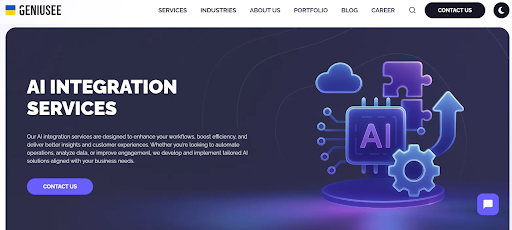
Geniusee AI integration services build custom AI for operational efficiency and revenue growth. Their work focuses on automating workflows, extracting data insights, and improving customer engagement. The aim is measurable business impact.
They build custom models for predictive analytics, computer vision, and NLP. They also work with generative AI to make internal data searchable, and they handle IoT integration for real-time edge processing.
What they deliver: End-to-end AI solutions from initial ideation and cost estimation to the integration of pre-built services and full-scale custom development. Their process includes rigorous data engineering to prepare client data for accurate AI modeling.
Best suited for
Best for fintech, edtech, retail, and real estate companies that need custom tools for specific operational problems. ROI matters—cost reduction, new revenue streams, things you can actually track.
2. LeewayHertz
LeewayHertz puts generative AI and automation into existing enterprise systems. They integrate with your existing systems instead of requiring a complete rebuild. The goal is to modernize workflows without causing disruption.
They embed LLMs and chatbots into current operations. They also do strategic consulting—looking at your systems and identifying where AI actually makes sense. Tech stack includes cloud platforms, MLOps, and API integrations.
What they deliver: Tailored AI apps, workflow automation, and ongoing optimization. Structured path from business analysis to post-deployment monitoring.
Best suited for
Best suited for mid-sized to large enterprises in banking, healthcare, and manufacturing. Companies that need a technical partner to handle generative AI adoption and scaling.
3. Accenture
Accenture is a global leader in management and technology consulting. They see AI as a driver of complete business reinvention. The approach is end-to-end transformation—building an AI-enabled digital core, establishing responsible AI frameworks, and preparing workforces.
They help organizations figure out where AI delivers the best ROI across the value chain. They break down data silos and build modern data foundations. They also set up governance frameworks to ensure AI deployments are fair and compliant.
What they deliver: Large-scale transformation—custom AI copilots, MLOps pipelines, AI Refinery platform. Covers technology sovereignty to workforce reshaping.
Best suited for
Large global corporations and public sector organizations are seeking a holistic transformation partner to address the strategic, technological, and human challenges of scaling AI responsibly across the entire enterprise.
4. Iflexion
Iflexion adds AI and machine learning to enterprise systems to automate work and get value from data. They have their own AI Center of Excellence for strong technical skills.
They handle the full ML process: data prep, model training, post-deployment tuning, and drift detection. Work in computer vision, NLP, and predictive analytics. ISO 9001 and 27001 certified — compliance is standard.
What they deliver: Complete AI integration—strategy, ETL, custom models, third-party integration. Plus post-launch retraining and tuning for long-term accuracy.
Best suited for
Established enterprises across healthcare, e-commerce, finance, and manufacturing that need a reliable partner to build, integrate, and maintain secure and scalable AI systems that improve operational accuracy and strategic decision-making.
5. IBM
IBM Consulting focuses on enterprise transformation when it comes to AI. Orchestration and governance are the main priorities. They help organizations move beyond isolated experiments and build unified AI projects using their WatsonX platform. The platform coordinates agents, data, and workflows across the entire business.
They specialize in agentic AI orchestration—designing platforms where multiple AI agents work together autonomously. This prevents fragmentation and ensures scalable outcomes. Governance is built into every stage.
What they deliver: End-to-end AI workflows and agentic applications. Architecture and governance to scale AI securely across the enterprise.
Best suited for
Best for large global corporations and public sector organizations. Complex AI systems need orchestration at scale. Built-in governance and security are critical. They need to unify disparate AI initiatives into one managed platform.
6. Binariks
Binariks is a tech consulting and software engineering firm. They build custom AI. Focus is on data science. Delivery centers in Europe and North America. They help businesses—especially in regulated sectors—turn data into systems for better decisions.
They specialize in healthcare, fintech, and pharma, emphasizing secure, compliant AI solutions. Their work spans generative AI, predictive ML, and computer vision, supported by complete lifecycle services.
What they deliver: Custom AI systems—chatbots, recommender engines, predictive models, computer vision tools—all integrated into existing operations.
Best suited for
Best for healthcare, fintech, logistics. Organizations that need secure, compliant, scalable AI. Better operations, customer experience, and growth.
Conclusion
The partner you pick for AI integration hits your efficiency and ROI hard. Get it wrong, and it’s wasted time and cash. Geniusee, LeewayHertz, Accenture, Iflexion, IBM, Binariks—these companies have the technical side covered, they’ve worked in real industries, and they know how to scale without breaking.
Look at your sector, data quality, and whether they offer ongoing support and compliance. Done right, you automate tasks, make better decisions, and improve operations.